Target Atlas
KickboxingMuay Thai

Calf Kick: How to Throw It and What Opens It

The calf kick goes in below the knee, under where most people look to check.

Tap any strike on this page to hear FightFlow call it
FightFlow TeamChecked October 12, 202613 sources

Quick answer

Where
The back and outside of their front lower leg, below the knee.
What reaches it
A round kick angled down into the calf, below the knee. Against an orthodox opponent: your rear leg to the outside of their front calf if you stand orthodox; as a southpaw, your lead leg to the outside or your rear leg to the inside.
Is it legal?
Depends on the rules. Banned in WAKO Low Kick, allowed in WAKO K1 and IFMA Muay Thai, and not listed as a foul in the Unified Rules of MMA.[1,2,3]
Why it works
Fighters say it hits the peroneal nerve. Nobody has tested that. One MMA case links a kick to the outer leg with sudden foot drop; the only paper we found that names the calf kick describes muscle damage.[4,5]

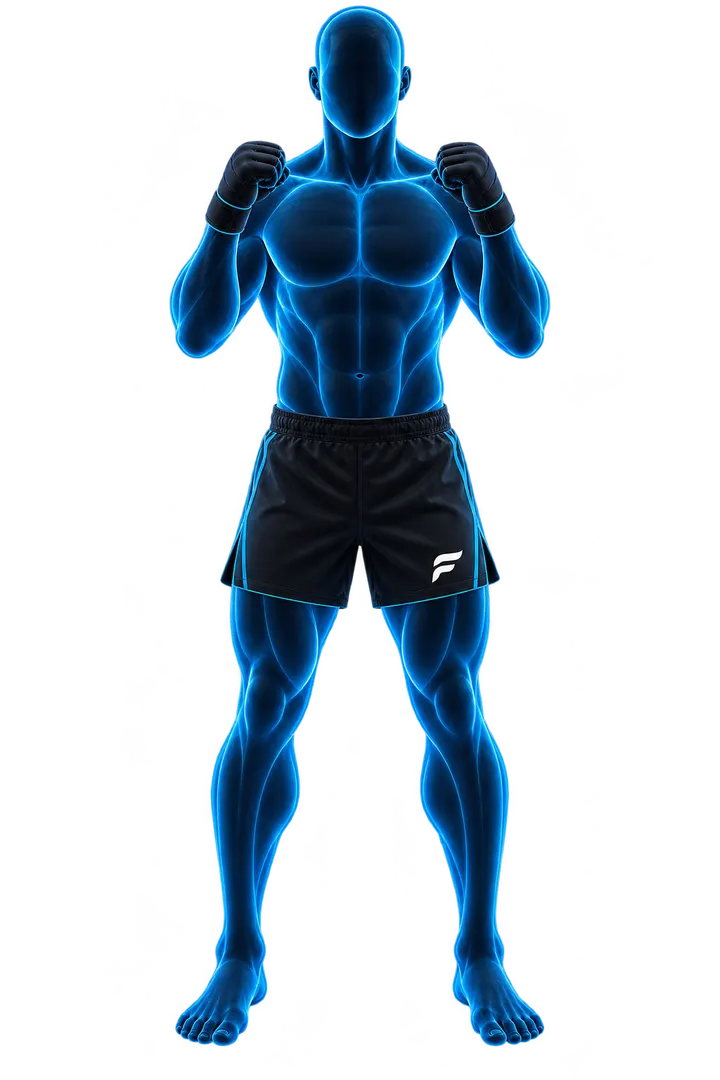
Orthodox opponent, facing you

Below the knee on their front leg

What reaches it

Your stance

Orthodox: left foot forward, the usual stance for right-handers. Southpaw is the mirror.

Tap a strike to hear the call exactly as FightFlow says it in a round.

Shown against an orthodox opponent, whose front leg is their left. An orthodox kicker lands on the outside of that calf with the rear leg. A southpaw lands on the outside with the lead leg, or on the inside with the rear leg.

How to throw a calf kick

  1. Step your lead foot slightly out so your hips can turn.
  2. Turn the hip over and chop down and across into the calf, below the knee, with the lower shin.
  3. The kick angles down rather than straight across like a low kick, so it lands below the knee, where a late check does not reach.
  4. Throw it when their weight is on the front leg, often as they step in or punch.
  5. Keep your lead hand up. The calf kick puts you in punching range.

What opens it

The calf kick lands best on a leg that is carrying weight and cannot lift to check. Kickboxing rules differ: WAKO Low Kick bans kicks at or below the knee, so check your rule set before you drill it for a fight.

Each exchange is shown for orthodox against orthodox. In the app the calls follow your stance, so as a southpaw you drill the mirror image, aimed at the other side. Tap Hear it and FightFlow calls it three times, at the pace it uses in a round, so you can shadowbox it.

Target

Front calf

They lean on the front leg

A planted leg cannot check.

You

Jab.

They

They step in or lean forward to punch back, with their weight on the front leg.

Finish

Rear calf kick.

A leg carrying weight cannot lift to check, and the kick comes in below where most people look.

In the app: Jab, calf kick

Open in FightFlow

Their eyes go up

Punch high, kick under the knee.

You

Jab, cross, lead hook to the head.

They

They cover the head and plant their feet.

Finish

Rear calf kick.

Punches high pull their attention up, and the hook turns your hips to load the rear leg.

In the app: Jab, cross, lead hook, calf kick

Open in FightFlow

Train it in FightFlow

Hear the setup, throw the shot

Every exchange above opens straight into FightFlow's Combo Builder, and FightFlow calls it out loud during your rounds in the same voice. 10 free training minutes a day.

Download on the App StoreGet it on Google Play

How to check a calf kick

  1. Check it like a low kick, but sooner: lift your lead foot and turn the shin out as soon as you see their hip turn.
  2. Keep the weight off your lead leg, so it is light enough to lift.
  3. If you cannot check it, take the weight off the leg so it gives with the kick, turn your lead foot out so it lands on the shin, or step back out of range.
  4. Answer with a cross as they kick. A calf kicker is in punching range.

Myths, checked

False

“Calf kicks hit the sciatic nerve.”

The sciatic nerve splits at or just above the back of the knee. Below that its branches have their own names: the tibial nerve runs deep under the calf muscles, and the common fibular nerve wraps around the outside just below the knee, where a blow can hurt it.[6,7]

False

“If you can walk on it, it is not broken.”

You may still be able to put weight on a leg with a broken fibula, the thinner bone on the outer side of the lower leg. Any suspected break needs the emergency department, even if you can walk.[8]

When to get checked

Go to the emergency department now, and do not drive yourself (ask someone to take you or call an ambulance), if after a kick the lower leg has pain far worse than the kick seems to explain, pain that keeps building, or pain that painkillers and raising the leg do not ease; a calf or shin that feels tight, swollen or hard; or tingling, numbness or weakness, even hours later or overnight. There is no safe time to wait and see. New trouble lifting the foot, or toes that catch or drag, needs a doctor the same day, even if it does not hurt.[9,10,11,12,13]

This page is general information, not medical advice. If you think you are hurt, see a doctor. Where your gym or governing body has stricter rules, follow them.

Learn the technique

Muay Thai vs. Kickboxing: The Real Differences Orthodox vs. Southpaw Footwork: Outside Foot and Safe Side

Sources

The medical and rules statements on this page come only from medical references, peer-reviewed studies and official rule books, each checked against the source text. Fight technique is our own. Last checked October 12, 2026.

  1. WAKO Rules: Full Contact, Low Kick and K1 Style. World Association of Kickboxing Organizations, 2022.
  2. IFMA Rules and Regulations. International Federation of Muaythai Associations, 2026.
  3. Unified Rules of Mixed Martial Arts. Association of Boxing Commissions and Combative Sports, 2026.
  4. Acute unilateral foot drop as a result of direct blunt trauma to the peroneal nerve in a professional mixed marital arts bout: A case report. South African Journal of Sports Medicine, 2017.
  5. Acute Compartment Syndrome Following Repeated Calf Kicks in an Elite-Level Kickboxing Athlete: A Case Report of a Rare Non-Fracture-Related Complication. Journal of Functional Morphology and Kinesiology, 2026.
  6. Anatomy, Sciatic Nerve. StatPearls, NCBI Bookshelf, 2023.
  7. Peroneal Nerve Injury. StatPearls, NCBI Bookshelf, 2024.
  8. Fibula Fracture (Broken Fibula). Cleveland Clinic Health Library.
  9. Compartment syndrome. MedlinePlus, US National Library of Medicine, 2024.
  10. Compartment Syndrome. OrthoInfo, American Academy of Orthopaedic Surgeons.
  11. Compartment syndrome. NHS, 2026.
  12. Acute Compartment Syndrome. StatPearls, NCBI Bookshelf, 2023.
  13. Foot drop. NHS, 2025.

More targets

Open the Target Atlas

Low kick

The outside and inside of their front thigh

Oblique kick

Their front knee, and just above it

Body shots

The three body targets, and their left side in depth