Boxing Stance: How to Stand and Keep It When You Move
We care about your privacy, so you should know: this video comes from YouTube, which may set cookies. Cookie Policy
Set up a boxing stance from the floor up, choose orthodox or southpaw, then test it with a 5-minute drill that calls every step, punch, and reset.
FightFlow Team
•
November 3, 2026
•
12 min read
Practice the movement
Put footwork into live solo rounds.
FightFlow builds footwork into live rounds with entries, exits, pivots, defense, and combo cues, so movement is part of the work instead of an afterthought.
Quick Verdict:
- Feet: about shoulder-width apart, one foot ahead, not in a straight line
- Which foot leads: most right-handers start left foot forward, most left-handers right foot forward
- Rear heel: slightly up
- Hands: up by your face, elbows in, chin down
- The test: after every step and punch, can you get back to it?
- In the app: open the 5-minute Stance Check in FightFlow
A stance can look right while you're standing still and fall apart when you move. Boxing Canada's reference manual for beginner coaches lists exactly that among its common errors.
So set it up once, then test it. Take a step, throw a punch, and see whether you can get back to where you started. If your feet have closed up or your rear hand has wandered off your face, that's what to work on.
Which Foot Goes Forward?
Orthodox and southpaw tell you which side leads.
| Stance | Lead foot and hand | Rear foot and hand |
|---|---|---|
| Orthodox | Left | Right |
| Southpaw | Right | Left |
Start with your stronger hand at the back: left foot forward if you're right-handed, right foot forward if you're left-handed. That's the usual starting point, not a law, and some boxers go the other way. If you're not sure, run the drill below in each stance and, if you can, have a coach watch. Then stay with one while you're learning.
This guide says lead and rear, so it works for both. Facing someone in the opposite stance changes your angles, and our orthodox vs. southpaw guide covers that.
How to Set Your Stance
The video at the top is 70 seconds with two-weight world champion Skye Nicolson, made for Hitfit. It shows the whole stance from the front: foot spacing, a slight knee bend, hands just under eye level, elbows in. It mentions both shoulder and hip width, so use the starting point below for yours. It doesn't cover your rear heel, foot angle, or chin, so read on for those.
Boxing Canada's manual corrects a stance in this order: lower body, shoulders, head, hands. Build yours the same way.
Feet
Stand with your feet about shoulder-width apart, then take a natural step forward with your lead foot. You want width and depth, so your rear foot isn't directly behind your lead foot. With both feet on one line, you're on a tightrope.
The manuals don't quite agree on width. Boxing Canada says shoulder width, and England Boxing's coaching handbook says a little wider. So test it with small steps in every direction. If the spacing makes your first step labored or your recovery awkward, adjust it slightly. Keep enough width and depth to finish balanced.
England Boxing has both feet aiming at about 45 degrees. Use that as a starting point, because coaches differ here, especially on how far the lead foot turns. Your feet should let you move and turn without forcing your knees.
Weight, heels, and knees
Start with your weight roughly even between your feet and your rear heel slightly up. Your lead heel can settle. Stay ready through the balls of your feet, but don't stand on tiptoe.
Bend both knees slightly, the rear one a little more. If you have to drop into a squat before you can move, you've gone too low.
Even weight is where you start, not where you stay. It moves every time you step or punch, and some fighters sit further forward or back on purpose.
Hips and shoulders
Turn partly side-on, with your lead side closer to your opponent. Square on, you're a bigger target. Turned too far, your rear hip and shoulder have trouble coming through on the cross.
Stay close to upright, with your head over the space between your feet. Lift your lead shoulder slightly toward your chin.
Hands and elbows
Let your arms hang, then bend at the elbows and bring your hands up until your thumbs are around cheekbone height. Your rear hand stays by your face, and your lead hand sits slightly further forward. Keep your hands closed but not clenched, because clenching runs up into your shoulders.
Keep your forearms close to vertical and your elbows in, so they cover your body without squeezing against your ribs.
Lead-hand height is a real coaching difference. Boxing Canada's manual carries it at shoulder height, and plenty of coaches keep it higher. Start where you can hold it without tensing, then let a coach adjust it.
Chin and eyes
Lower your chin and look at your opponent through your eyebrows. Don't force your chin onto your chest. England Boxing warns that it puts tension in your shoulders.
Stances, Guards, and Styles
Lists of "boxing stances" tend to mix things that aren't the same kind of choice. You can be a southpaw in a crouch with a high guard.
| Term | What it describes | What to know |
|---|---|---|
| Orthodox, southpaw | Which side leads | You'll use one of these whatever else you do |
| Switch-hitting | Working from both sides | Get one stance reliable first |
| Upright, crouch | How low you stand | A crouch asks more of your legs |
| Wide, narrow | How far apart your feet are | Too wide can slow your movement. Too narrow leaves a poor base for punching |
| High guard | Where your hands are | Hands high around the head, forearms and elbows placed to cover. Footwork and head movement still matter |
| Peek-a-boo | A whole system | A tight guard combined with coordinated head movement, entries, and footwork |
| Philly shell | A defensive system | Lead arm across the body, rear hand protecting the head, lead shoulder helping deflect punches. It takes trained positioning and timing |
Start with the plain version in this guide. Boxing Scotland's coaching toolkit teaches beginners a classic stance and adapts it later, for example for tall or short boxers.
Your Stance Moves, Then Comes Back
A stance that never changes isn't the goal. On a cross, your rear foot turns, your hip comes through, and your weight moves forward. Keep your balance as you turn, without falling over your lead leg. What you're testing is whether you can get back.
Steps. Move the foot nearest the direction first, then let the other foot follow the same distance: lead foot to step in or to the lead side, rear foot to step back or to the rear side. Boxing Canada's rule is that your feet never cross or come together.
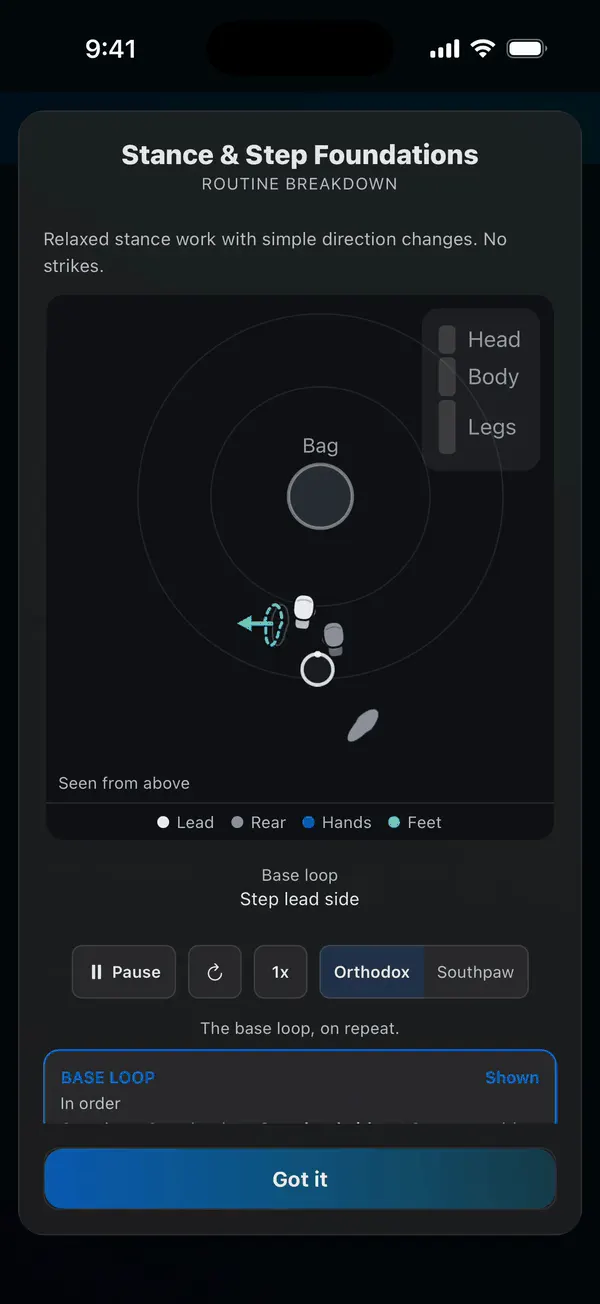
That clip is from FightFlow's Footwork Drills, seen from above in orthodox stance, and it shows the feet only.
Jab. Your lead hand goes out and comes back. Your rear hand stays by your face and your chin stays down.
Cross. Let your rear foot turn with your hip. When your hand comes home, your hip and foot come back too, so you aren't left standing square.
Step and jab. The jab can land as your lead foot lands. Your rear foot follows, and you get your stance back before you throw the cross.
The Stance Check: 5 Minutes, Called Out Loud
We built this one as a combo, so FightFlow's voice can run it. Open Stance Check in FightFlow. The table is what you'll hear, in this order, at Slow pace. The sequence takes about a minute and repeats for the whole 5 minutes.
| Part | The calls | What to look for |
|---|---|---|
| Set up | Reset | Get into your stance: feet, knees, hands, chin |
| Steps | Step in, Step back, Step lead side, Step rear side, Reset | Each call is one whole step, both feet. Same width and depth at the end of each |
| Single punches | Jab, Reset, Cross, Reset | Jab: your rear hand stays up. Cross: your rear foot and hip come back |
| The 1-2 | Jab, Cross, Reset | The jab comes back as the cross goes out |
| Step and punch | Step in + Jab, Cross, Step back, Reset | Rear foot has followed before the cross. Rear foot goes first on the way out |
| Side steps | Step lead side, Jab, Step rear side | Both feet settle before the jab. Keep facing the same way |
Then it's back to Reset, and the sequence starts again. Tap a call to hear it.
Three rules make it work:
- Punch at about half speed. There's no target, so control the extension and don't snap your elbow straight.
- Your hand comes back with the punch. Don't wait for the call. "Reset" is when you check feet, knees, hands, and chin.
- Keep the steps small. Each part brings you back about where you started, so two steps of clear floor in every direction is enough.
It's light work, which makes it a decent way to start a session. If you're cold, walk around and roll your shoulders for a minute or two first. The calls say lead and rear, so it works in either stance.
FightFlow calls the drill and doesn't watch you. Boxing Canada suggests checking your stance in a mirror while you're learning, and FightFlow's Reels can record a session so you can check it afterward.
In the app, the link opens the combo with its steps listed. Tap Save & Start. You can change the pace or length there too. It stays in your Combo Builder list, so start it from there next time. The app won't save a second combo with the same name. With Numbered callouts on in Settings, the separate Jab and Cross calls become 1 and 2. On the free plan, it uses about 5 of your 10 active minutes a day, shared with the rest of your training.
When it gets boring, take the stance somewhere: our shadow boxing guide adds an opponent, footwork drills add angles and pivots, beginner combinations add more punches, and heavy bag workouts add contact.
What Usually Goes Wrong
We care about your privacy, so you should know: this video comes from YouTube, which may set cookies. Cookie Policy
Olympic medalist Tony Jeffries shows five common ones with a training partner: standing square, standing too tall, chin too high, elbows too high, and feet on one line. There's a sponsor read from about 2:40 to 3:40.
During the drill, check these too:
Your feet close up after a step. Check that your first foot keeps its sideways offset and that the following foot stops at your original spacing.
Your stance gets longer. Your two feet may be covering different distances. Shorten the first step and let the following foot restore your original depth.
Starting a step feels slow. England Boxing warns that too much width slows quick foot movement. Check your spacing and where your weight is.
Your rear heel is flat. England Boxing says a flat back heel hinders quick foot movement. Lift it slightly. You don't need to stand on tiptoe.
You're square after the cross. You may be over-rotating or not recovering after the punch. Slow it down and finish balanced, in guard, ready to move.
Your other hand drops when you punch. Watch the hand that isn't punching. Slow down until it stays in guard.
Your chin comes up when you move. England Boxing names moving forward and back as the moments it happens. Watch it on the step calls.
More in beginner boxing mistakes.
If You Kick
A boxing stance isn't built for kicks, so it changes when kicks and checks come in. For Muay Thai, use a more upright, squarer stance with relaxed knees. ONE's stance guide has your hips facing your opponent's. Shifting your weight onto your rear leg frees your lead leg to teep or check, and your weight should change with the action.
Kickboxing depends on the rules and the gym, so treat these as tendencies, not rules. Stance Check is a boxing drill. It won't test whether you can lift your lead leg in time.
Frequently Asked Questions (FAQ)
What is the correct boxing stance for a beginner?
Feet about shoulder-width apart or a little wider, one foot ahead and offset from the other, rear heel slightly up, knees slightly bent, body partly side-on, hands up by your face, chin down. Adjust it until you can step in any direction and get back to it.
Which foot goes forward in a boxing stance?
Most right-handers start with the left foot forward (orthodox) and most left-handers with the right foot forward (southpaw), so the stronger hand is at the back. It's a starting point, not a rule.
Can a right-handed boxer fight southpaw?
Yes. Handedness is only the usual starting point. If you're not sure, try both and, if you can, have a coach watch. Then stay with one while you're learning.
How wide should a boxing stance be?
Start around shoulder width or a little wider, with one foot forward and offset. Test small steps in every direction. If the spacing makes your first step labored or your recovery awkward, adjust it slightly. Keep enough width and depth to finish balanced.
Should my heels touch the floor?
In this basic stance, keep your rear heel slightly up. Your lead heel can settle, and it comes up when a punch or step needs it. Stay ready through the balls of your feet without standing on tiptoe.
Should my weight be 50/50?
Start roughly even between your feet. It won't stay there, because your weight moves every time you step or punch. Some fighters also sit further forward or back on purpose.
Keep reading
Orthodox vs. Southpaw Footwork: Outside Foot and Safe Side
•
8 min read
A simple guide to closed stance, open stance, outside foot position, safe-side exits, and why stance matchups change defensive footwork.
Head Movement and Footwork: Move Out of Attacks
•
9 min read
A plain guide to moving your head and feet together, with stance matchups, exit lines, punch defense, Muay Thai adjustments, and drills.
How to Move Out of Punches: Jab, Cross, Hooks, and Uppercuts
•
8 min read
A punch-by-punch guide to moving your head and feet out of jabs, crosses, hooks, uppercuts, overhands, and body shots.
Train it with FightFlow
Voice-led rounds for boxing, kickboxing, and Muay Thai. Free for 10 active minutes a day.