How to Shadow Box: Technique and a 10-Minute Routine
Start in place, then build a short exchange you can finish balanced. How to shadow box without a bag or partner, with a 10-minute beginner routine.
FightFlow Team
•
November 2, 2026
•
11 min read
Drill it without staring at a screen
Make boxing homework more structured.
Use FightFlow for pad-style solo rounds with combo chains, defensive reactions, footwork, target calls, and saved routines you can run at home or on the bag.
Quick Verdict:
- What it is: moving and punching against an opponent you imagine
- Equipment: none. No bag, gloves, or wraps.
- Space: about two steps of clear floor in every direction
- Time: 10 minutes for the routine below
- Start with: the jab, standing in place
- In the app: open the 6-minute version in FightFlow
For your first round, punch in place without stepping. Throw single jabs, add the cross once you can get your guard and balance back, and let your rear foot turn with your hip when you do. Add a step after that. It's fewer things to coordinate, and a punch that pulls you off balance won't improve once your feet are moving too.
Boxing Canada's reference material for beginner coaches lists the same order among its warm-up exercises: shadow boxing on the spot, then with short steps.
From there you're building toward a short exchange you can finish balanced, with your hands up and somewhere to go next.
What Is Shadow Boxing?
Shadow boxing is practicing punches, footwork, and defense in the air against an opponent you imagine. You don't need a bag, gloves, or a partner.
It's good for rehearsing technique and decisions. It can't show you whether your distance and timing work against someone who is moving and hitting back, so take it to pads and a partner when you can.
For the mental side, we covered one small study of professional Muay Thai fighters.
How to Shadow Box, Step by Step
1. Get in your stance
- Feet about shoulder-width apart, lead foot forward, rear heel slightly off the floor.
- Knees relaxed, weight over your base.
- Chin down, hands by your cheekbones, elbows in.
| Stance | Lead side | Rear side |
|---|---|---|
| Orthodox (left foot forward) | Left | Right |
| Southpaw (right foot forward) | Right | Left |
For the full setup, see our boxing stance guide.
Punch numbers in this guide: 1 = jab, 2 = cross.
2. Throw the jab in place
Stand still and throw single jabs. Your lead hand goes out and comes back along the same line while your rear hand stays by your cheek. Breathe out with each punch.
Reach where their chin would be. There's no target to meet your fist, so control the punch both ways and don't snap your elbow into lockout. Don't fix that by shortening the punch. Slow it down until you can reach and come back under control.
3. Add the cross
Drive through your rear leg and turn your hip and shoulder with the punch, letting your rear foot turn too. Your weight moves toward your lead leg without falling over it.
The jab comes back as the cross goes out, so there's no need to stop and touch your cheek between punches. After the cross, your rear hand comes home and you should still be in your stance. If you're leaning or you've spun out of it, go slower.
4. Add the step
Step in with the jab: the lead foot moves first, and the rear foot follows the same distance. The jab can land as the lead foot lands. Get your stance back, then throw the cross. To step back, move the rear foot first and let the lead foot follow. For a sideways exit, move the foot nearest that direction first.
For now, hold the cross back until your feet are under you. Keep your feet from crossing or closing up, because you need that base for whatever you do next.
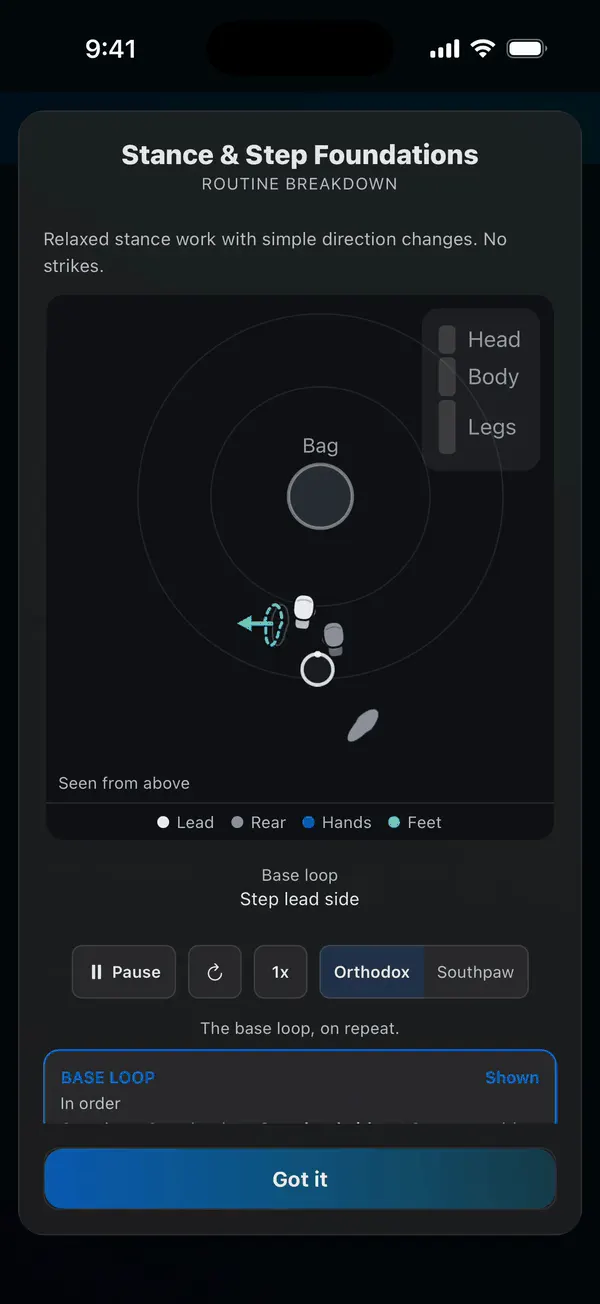
That clip is from FightFlow's Footwork Drills, seen from above in orthodox stance, and it shows the feet only. If your feet keep coming together, spend a round on the stance walks in our footwork guide first.
5. Put someone in front of you
Now give yourself an opponent: one person, at a believable distance, with one habit. A good first habit is that they jab back after your cross.
That gives you a reason to get your hands back up and leave, and it stops you admiring your last punch. Aim at where their chin and body actually are, because a punch with no target drifts. You don't need to imagine a whole fight.
6. Finish the exchange
After the cross, get your guard up against their return jab, then step back or take a small angle out. Keep facing them.
Then check yourself. Could you throw again right now, or move? If not, your feet have probably come together or your weight has tipped over your lead foot. That's the thing to fix.
Leaving after every exchange is a training rule for this routine, not a rule of boxing. In a fight you might hold your ground, defend, or keep punching.
A 10-Minute Shadow Boxing Routine
These aren't punch-outs. Do one exchange, reset, and do it again. The timings are a starting point we chose, and if you need a longer warm-up, take one.
| Time | What to do |
|---|---|
| 0:00–2:00 | Warm up: easy movement and shoulder rolls, then slow stance walks and light single punches |
| 2:00–4:00 | Round 1, in place: jabs for the first minute, then the 1-2 for the second. Come back without leaning or spinning out of your stance |
| 4:00–5:00 | Rest |
| 5:00–7:00 | Round 2, add the step: step in with a light jab, get your stance back, cross, get your guard back, step out |
| 7:00–8:00 | Rest |
| 8:00–10:00 | Round 3, add the opponent: 1-2, guard up against their return jab, then step back or take a small angle out |
Open "Shadow Boxing Basics" in FightFlow
That adds the three rounds to your Shadowboxing list as one scenario with four blocks: jabs in place, 1-2 in place, the step, then the full exchange, 6 minutes in total. When FightFlow opens, tap Add to keep it, or Save & Start Session to go straight in. The screen shows which block you're on and which one is next. Warm up first. There's no rest built in, so tap Pause when block 3 begins and again when block 4 begins, rest for a minute, then tap Resume.
What to add next
Once all three rounds stay clean, add one of these at a time:
- Defend first. They jab. You slip or parry it, answer with one punch, and reset. Against an opponent in your stance, slipping outside their jab moves you toward your rear side, which loads your cross. Our guide to slips and parries has the details.
- Angle off the jab. Step in with the jab, step off to the side, get your stance back and face them, then throw the cross. Take this one slowly, and learn that order before you try punching while you move sideways.
- A free round. Any punches, one to four at a time, and each exchange still gets an ending. Our 15 beginner combinations give you plenty to choose from.
How Long and How Often Should You Practice?
Start with the session above. Two rounds also work on their own before bag or pad work, and our home boxing workout is there when you want 30 minutes.
There's no set number of days. Repeat it when you've recovered from your other training, and cut it short when your technique starts to slip. When it feels easy, change one thing: 3-minute rounds, an extra round, or a little less rest.
Habits to Drop
Looking at your hands or feet. Keep your chin tucked and your gaze level. A mirror helps you check something specific, such as whether your rear hand drops when you jab, but do some rounds without one too. Filming a round lets you check afterward, and FightFlow's Reels can record a session.
Going fast too soon. Speed up only while your reach, your recovery, and your balance stay controlled.
Reaching with your head. If they're too far away, step. Leaning to reach puts your chin out front and your weight over your lead foot.
Slips you can't explain. When you drill a slip, picture the incoming punch and know where your head finishes relative to it. Keep it small enough that you can counter or move afterward.
Bouncing because it looks like boxing. Stay ready through the balls of your feet with relaxed knees. Bouncing all round for no reason just tires your legs.
Long combinations, for now. In this routine, keep exchanges to one to four punches so you can check your balance, guard, and ending before you go again.
Hand weights. Leave them out while you're learning this. They change how your arm starts and stops, and that's what you're practicing.
If You Kick
The same progression works for kickboxing and Muay Thai, with one more balance problem: nothing stops the kick, so you have to bring it back yourself. Start slowly and put each kick back down in your stance, hands up, before you do anything else.
For Muay Thai, use a more upright, squarer stance with relaxed knees. Shifting your weight onto your rear leg frees your lead leg to teep or check, and your weight should change with the action. Your exits and head movement change too once kicks and knees are in play. Our Muay Thai solo drills go further.
Train It in FightFlow
Once you know the movements, the hard part is keeping to the rules when you're tired. FightFlow's Shadowboxing mode says the rules out loud and leaves the punches to you.
When a block starts, FightFlow calls its rules, for example: "Attack: Straights. Intent: Flow. Defense: Reset guard every exchange. Mix: Free strike mix." Then the voice mostly stays out of the way, with short reminders like "Snap and recover" or "Defend, then exit", and a 10-second warning before the block ends. The rules stay on screen until the block changes. It doesn't call each punch and it doesn't watch you, so what you throw and whether it's clean are up to you.
Shadow Boxing Basics has the six minutes of work from the routine above. Follow the block names on screen: the first minute is single jabs only, even though the voice says "Straights" and "Free strike mix". On the free plan, its 6 minutes come out of your 10 active minutes a day, shared with the rest of your training.
After that, try the presets Jab-Only Shadow (the rules say straights, so keep yourself to the jab), 1-2 With Exit, and Slip and Exit. If you kick, try Front Kick Range, Low Kick Setup, Teep Range, or Check and Return. Those run three 45-second blocks, 2:15 in total. You can also build your own scenario with up to 8 blocks and set the length of each one, or use Rounds Mode to run scenarios one after another with rest between them.
If you'd rather be told exactly what to throw, that's a different drill. Quick Train and Combo Builder call the punches and you answer. Tap a call to hear it.
Choosing between apps? Our boxing app comparison covers the options.
Frequently Asked Questions (FAQ)
What should beginners throw first?
The jab, standing in place. Add the cross once your balance and guard stay controlled, then add a step. Bring in other punches after that.
How long and how often should I shadow box?
Start with the 10-minute session in this guide. There's no set number of days. Repeat it when you've recovered from your other training, and cut it short when your technique starts to slip.
Do I need a mirror to shadow box?
No, but one helps you check something specific, such as whether your other hand drops. Keep your gaze level, and do some rounds without it too.
Should I shadow box with weights?
Leave them out while you're learning the movements in this guide. They change how your arm starts and stops, and that's what you're practicing.
Can shadow boxing teach me to fight?
It can help you rehearse movements and decisions. It can't show you whether your distance and timing work against someone who is moving and hitting back. That takes pads and a partner.
Keep reading
Heavy Bag Workout: 4 Routines, Beginner to Intermediate
•
12 min read
Four heavy bag workouts, from 1-minute to 3-minute rounds, with every call written out. Open any of them in FightFlow and hear those same calls, rests built in.
How to Throw an Uppercut: Power, Setups, and Solo Drills
•
7 min read
The uppercut isn't a wind-up. It's a hidden weapon. How to throw it with hip drive, set it up behind the jab, and drill it solo without dropping your guard.
Home Boxing Workout (No Equipment): A Real Fighter's 30-Minute Plan
•
8 min read
A real boxing workout you can do at home with zero equipment. Not cardio kickboxing: proper rounds, footwork, and combos written by fighters for fighters.
Train it with FightFlow
Voice-led rounds for boxing, kickboxing, and Muay Thai. Free for 10 active minutes a day.