Target Atlas
BoxingKickboxingMuay Thai

Jaw Shot: How to Land It and What Opens the Guard

Every striking style aims at the chin and the jaw.

Tap any strike on this page to hear FightFlow call it

See also:

Temple shots
FightFlow TeamChecked October 12, 202614 sources

Quick answer

Where
The chin, on the center line, and the jaw either side of it.
What reaches it
In every style, the jab, cross, hooks and uppercuts. In kickboxing and Muay Thai also head kicks and knees, and in Muay Thai elbows.
Why knockouts happen
Blows that spin the head fast are thought to be the main cause of concussion, and fighters believe a hook to the jaw spins it hardest. That second part rests mainly on one lab study and is not proven.[1,2,3,4]

Orthodox opponent, facing you

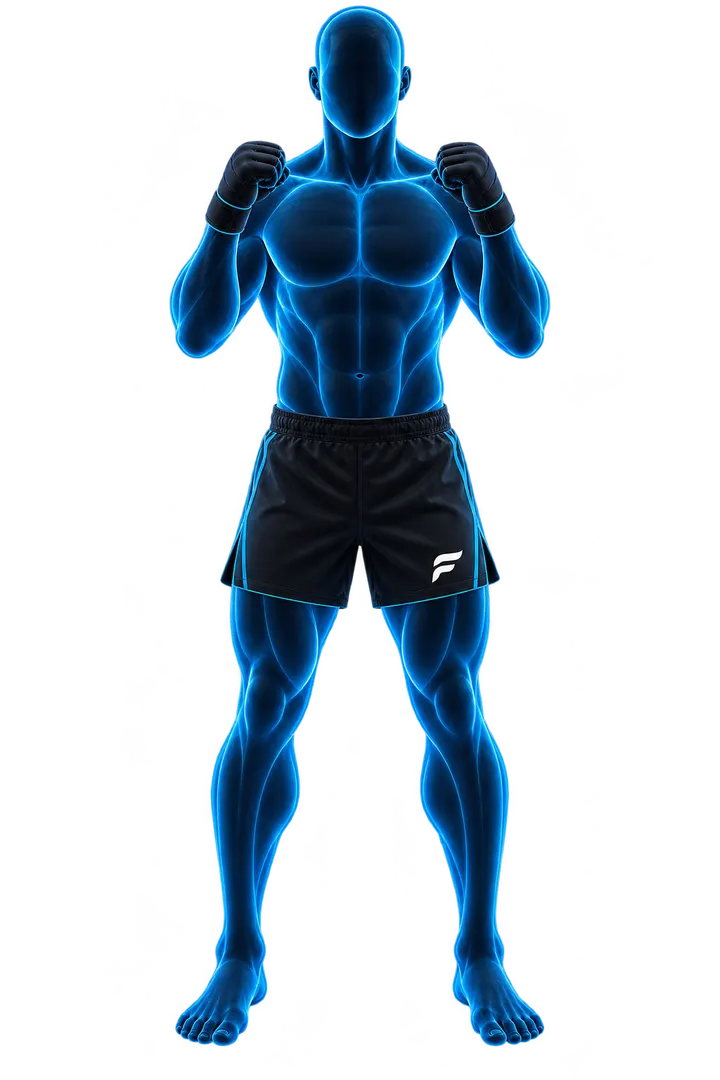
The chin and the jaw

What reaches it

Your style

Tap a strike to hear the call exactly as FightFlow says it in a round.

Knees count as kickboxing here because WAKO K1 rules allow them. WAKO Full Contact and Low Kick rules do not.[5]

How to land a shot on the jaw

Fighters aim to turn the head: a hook across the side of the jaw, or an uppercut that lifts the chin.

  1. Hook: elbow up at shoulder height, turn your hip and foot with it, and hit through the side of the jaw rather than at it.
  2. Uppercut: dip with your knees, keep the hand by your chin, then drive up from the legs so the fist rises inside their guard.
  3. Straight shots land on the chin when their hands are wide or low. Aim at the point of the chin.
  4. The shots that land clean are the ones they do not see coming, so set them up rather than loading up.
  5. Keep your other hand on your chin, and bring each hand straight back after it lands.

What opens it

A tight guard covers most of the head. It opens when a hand drops to protect the body, or when the head moves into the path of a punch.

Each exchange is shown for orthodox against orthodox. In the app the calls follow your stance, so as a southpaw you drill the mirror image, aimed at the other side. Tap Hear it and FightFlow calls it three times, at the pace it uses in a round, so you can shadowbox it.

Target

Chin and jaw

They drop an elbow to the body

Defending low leaves the jaw.

You

Lead hook to the body.

They

Their right elbow drops to cover the liver. That glove leaves the jaw.

Finish

Lead hook to the head.

Double the hook, body then head. The hand that covered the body is no longer by the jaw.

In the app: Lead body hook, lead hook

Open in FightFlow

They duck under the hook

The head comes down and forward.

You

Lead hook to the head.

They

They duck under it. Their head drops and comes forward.

Finish

Rear knee as the head comes down.

A duck moves the head down and forward, straight into the path of an uppercut or a knee.

In the app: Lead hook, rear knee

Open in FightFlow

Train it in FightFlow

Hear the setup, throw the shot

Every exchange above opens straight into FightFlow's Combo Builder, and FightFlow calls it out loud during your rounds in the same voice. 10 free training minutes a day.

Download on the App StoreGet it on Google Play

How to protect your jaw

  1. Chin down, shoulders up a little, gloves high by your cheekbones.
  2. Keep your eyes on them, especially their shoulders and hips.
  3. Against the hook, block with the glove and forearm tight to your head, or roll under it by bending your knees, not your waist, eyes on them.
  4. Against the uppercut, keep your elbows in front and the gap between your gloves closed, and do not duck straight down in front of them.
  5. Move your head after you punch. Staying on the center line invites the counter.

Myths, checked

False

“You are only concussed if you get knocked out.”

Concussion consensus statements and ringside physicians are clear that you can be concussed without losing consciousness or going down.[6,7]

False

“Headgear prevents concussion.”

Headgear lowers head acceleration in lab tests and cuts down facial cuts, but no study shows it prevents concussion.[8,9,10]

When to get checked

If you or your partner might be concussed, stop at once, even if you feel fine, and get checked by a doctor within 24 hours. Do not train or spar again until a doctor who knows concussion has cleared you, and never spar or compete with any symptom.

Call your local emergency number (999 UK, 112 EU, 911 US) or go to an emergency department straight away if, after a blow, the person:

  • was knocked out, even briefly
  • is very drowsy, is getting more drowsy, or cannot be woken
  • has a bad headache, or one that gets worse
  • vomits more than once
  • has a seizure, weakness, numbness or double vision
  • has slurred speech, is confused, or is getting more confused
  • has one pupil bigger than the other
  • has clear fluid from the nose or ears, or a cut, swelling or bad pain where they were hit
  • seemed fine, then gets worse

If a neck injury is possible, do not move them; wait for trained help. For the first 24 hours, do not leave them alone and they should not drive. No alcohol for 24 hours, or for as long as symptoms last.[7,11,12,13,14]

This page is general information, not medical advice. If you think you are hurt, see a doctor. Where your gym or governing body has stricter rules, follow them.

Learn the technique

How to Throw an Uppercut: Power, Setups, and Solo Drills Boxing Defense 101: Slips, Ducks, and Parries (Solo Drills Included) Boxing Counter Punching: Timing, Traps, and Drills (A Fighter's Guide) Concussions and Head Trauma in Combat Sports: What Fighters and Coaches Need to Know

Sources

The medical and rules statements on this page come only from medical references, peer-reviewed studies and official rule books, each checked against the source text. Fight technique is our own. Last checked October 12, 2026.

  1. Biomechanics of concussion. Clinics in Sports Medicine, 2011.
  2. Why most traumatic brain injuries are not caused by linear acceleration but skull fractures are. Frontiers in Bioengineering and Biotechnology, 2013.
  3. Rotational head acceleration and traumatic brain injury in combat sports: a systematic review. British Medical Bulletin, 2022.
  4. Head dynamic response and brain tissue deformation for boxing punches with and without loss of consciousness. Clinical Biomechanics, 2019.
  5. WAKO Rules: Full Contact, Low Kick and K1 Style. World Association of Kickboxing Organizations, 2022.
  6. Consensus statement on concussion in sport: the 6th International Conference on Concussion in Sport, Amsterdam 2022. British Journal of Sports Medicine, 2023.
  7. Concussion management in combat sports: consensus statement from the Association of Ringside Physicians. British Journal of Sports Medicine, 2019.
  8. Headguard use in combat sports: position statement of the Association of Ringside Physicians. The Physician and Sportsmedicine, 2024.
  9. Boxing headguard performance in punch machine tests. British Journal of Sports Medicine, 2015.
  10. Concussions, cuts and cracked bones: a systematic literature review on protective headgear and head injury prevention in Olympic boxing. European Journal of Sport Science, 2022.
  11. UK Concussion Guidelines for Non-Elite (Grassroots) Sport. Sport and Recreation Alliance (UK), 2024.
  12. Symptoms of Mild TBI and Concussion. US Centers for Disease Control and Prevention, 2025.
  13. Epidural hematoma. MedlinePlus, US National Library of Medicine, 2024.
  14. 112: the European emergency number. European Commission.

More targets

Open the Target Atlas

Temple shots

The side of the head, on both sides

Liver shot

Their right side, behind the ribs

Solar plexus

The center, just below the breastbone